
How a growing trust deficit is threatening AI adoption
The reaction was striking.
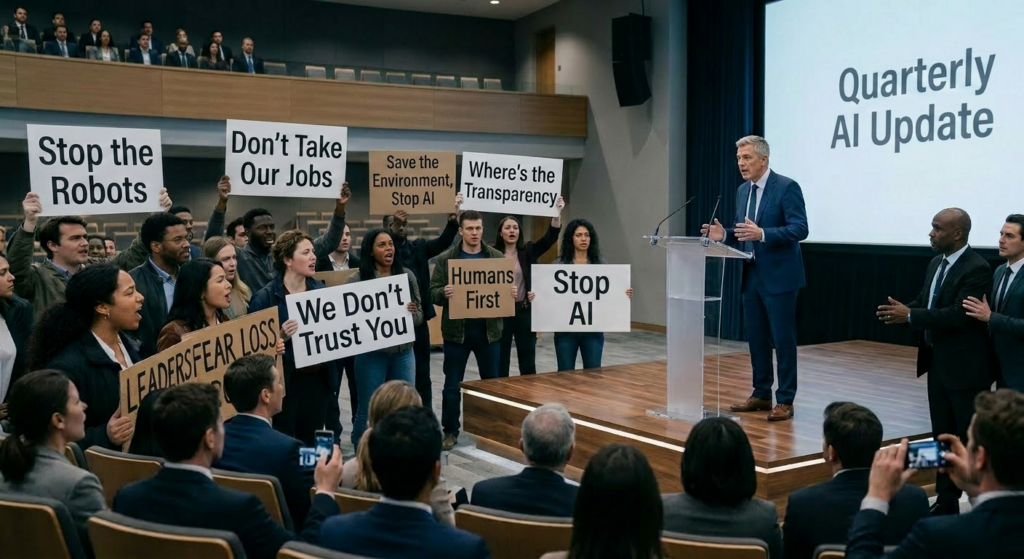
At commencement ceremonies across North America, several speakers who enthusiastically promoted artificial intelligence were met with boos from graduating students. Their comments about AI as the future of work and productivity generated visible discomfort and, in some cases, outright hostility.
Yet around the same time, Apple co-founder Steve Wozniak delivered a very different message. He acknowledged the opportunities presented by technology while emphasizing human responsibility, critical thinking, and the need to remain vigilant about AI’s risks. His comments were met with applause.
The contrast is revealing.
If artificial intelligence itself were the problem, both reactions should have been similar. Instead, audiences responded very differently.
The difference was not the technology. The difference lies in how AI has been presented – by governments, tech CEOs, organizational leadership, investors, and influencers. We’ve done a horrific job of rolling out and introducing AI. Maybe even worse than we did with social media. When it comes to AI, trust has become the scarcest resource in the system.
AI Didn’t Create the Trust Problem
One of the mistakes we make when discussing AI is assuming that public skepticism stems from AI itself.
It didn’t.
AI arrived at a moment when trust in many of our institutions was already fragile.
Trust in government has declined. Trust in the media has declined. Trust in corporations has declined. Trust in technology companies has declined.
People are increasingly skeptical of institutions that promise benefits while appearing disconnected from the consequences experienced by everyday citizens.
AI entered this environment carrying the expectations of a transformative technology, but it inherited the credibility challenges of the institutions introducing it.
This is an important distinction.
Many leaders believe they are asking stakeholders to trust a technology. In reality, stakeholders are being asked to trust the organizations deploying it.
And those are not the same thing.
The public is evaluating AI through the lens of existing experiences with privacy breaches, misinformation, social media harms, economic disruption, and institutional opacity.
Viewed through that lens, skepticism becomes far more understandable. AI did not create the trust deficit. It exposed it. And in many cases, amplified it.
We Focused on Capability While Trust Was Eroding
For a couple of years, AI conversations have centered on capability and efficiency. The public has been told that AI will make organizations more productive, efficient, innovative, and competitive. Employees have been told they could focus on the stuff they love to do, not the mundane administrivia. Investors have been promised higher margins and quick returns. In some circles, we’ve been promised that ever-elusive work-life balance. Perhaps one day these claims may prove to be true.
But reputation is no longer determined primarily by what organizations and leaders say.
Reputation is determined by how stakeholders interpret intentions and how they connect to proof and reality. The patterns organizations create, and the signals those patterns generate, become the true measure. It goes back to a foundational Do-Say-Are alignment, where what organizations do and say aligns with what they really are at the core – the heartbeat of the company, if there is one.
And increasingly, stakeholders appear unconvinced that the benefits of AI will be distributed fairly, transparently, or responsibly.
Employees are asking whether AI will augment their roles or replace them. Students are asking whether the skills they spent years acquiring will remain valuable.
Previous technological disruptions were often experienced first by workers with limited influence over public narratives. AI is different. It is increasingly affecting knowledge workers, creators, analysts, researchers, and professionals, the very people who shape public discourse. As a result, concerns about AI are becoming highly visible, highly amplified, and increasingly difficult for organizations to ignore.
Consumers are asking how their data is being used. Communities are asking whether they will share in the benefits or simply bear the costs.
While organizations have been speaking about capability, stakeholders are worrying about the consequences. And in that gap, trust erosion expanded.
Perhaps the clearest example emerged during commencement season. Speakers celebrating AI’s transformative potential were met with boos from graduates uncertain about their future place in the workforce. Yet Steve Wozniak’s message, grounded in responsibility, human judgment, and accountability, was received very differently.
The technology had not changed. The story had. And stories shape trust long before experience has a chance to.
The Signals We Sent
If AI inherited a trust deficit, it also inherited the responsibility to overcome it.
Instead, many of the signals stakeholders received reinforced the very concerns they were already carrying.
Organizations celebrated productivity gains while simultaneously announcing workforce reductions.
Students entered a labor market filled with uncertainty about which skills would remain valuable.
Technology leaders spoke about a transformative opportunity while warning about the risks of losing control of the technology.
Communities were asked to accept large-scale AI infrastructure projects without fully understanding the environmental or economic implications.
Creators watched organizations deploy tools trained on content they helped produce while legal and ethical questions remained unresolved.
Consumers were promised more personalized experiences even as they grew increasingly concerned about privacy, misinformation, deepfakes, and the erosion of human oversight.
None of these developments alone created a reputation problem.
Viewed individually, they seem disconnected. Collectively, however, they form a pattern.
And patterns matter because patterns become signals, and signals shape trust. And trust ultimately determines whether innovation creates value or resistance.
The Reputation Equation
One of the mistakes organizations continue to make is treating reputation as a communications outcome.
It is not.
Reputation is the accumulated result of observable behavior. It emerges from the patterns organizations create and the signals those patterns send.
This is particularly relevant in the context of artificial intelligence. Organizations often assume that trust can be generated through announcements, policies, governance frameworks, or carefully crafted messages.
These actions matter.
But stakeholders pay far more attention to behavior than promises. They are looking for proof points and relationships.
When an organization announces a commitment to responsible AI while simultaneously reducing its workforce without explanation, stakeholders notice.
When a company promotes innovation while remaining opaque about how data is collected, used, and protected, stakeholders notice.
When leaders discuss efficiency but fail to explain how employees will be supported through transition, stakeholders notice.
Over time, these observations accumulate.
The resulting reputation may have little to do with what the organization intended to communicate and everything to do with what stakeholders believe they have seen.
This is why reputation functions much like currency.
Its value is not determined by the organization issuing it. Its value is determined by the market evaluating it. And today, that market includes employees, customers, communities, regulators, investors, and increasingly, AI itself.
Governance Is Necessary. It Is Not Sufficient.
Many organizations have responded to concerns about AI by focusing on governance.
Governance matters.
The Global Alliance Responsible AI Principles were developed to help organizations promote transparency, accountability, human oversight, fairness, privacy protection, and responsible use of AI. These principles remain critically important because trust requires a foundation of responsible behavior.
But governance alone cannot solve AI’s reputation challenge.
In fact, much of the current public anxiety surrounding AI has emerged despite growing governance efforts.
The reason is straightforward. Governance addresses how organizations manage risk. Trust addresses how stakeholders experience change. Governance helps prevent harm. Trust helps create confidence. Organizations need both.
Our own research illustrates this tension.
Organizations increasingly recognize AI as both a significant reputational opportunity and a significant reputational risk.
At the same time, preparedness around employee welfare and change management remains remarkably low, with only a small percentage of organizations reporting they are fully prepared to support workforce transitions associated with AI adoption.
This suggests that the governance curve continues to lag behind the deployment curve.
More importantly, it suggests that the human transition curve may be lagging even further behind.
AI’s Real Challenge Is Transformation
For all the discussion about governance, algorithms, regulation, and policy, AI’s greatest challenge may be far more familiar.
It is change.
Organizations are implementing one of the most significant workplace transformations in modern history. Yet many are approaching it as a technology deployment rather than a human transition.
Technology adoption is relatively straightforward. Human adaptation is not. People need context. They need clarity. They need participation. They need to understand how change affects their future, their work, their identity, and their opportunity.
Without those elements, uncertainty fills the void. And uncertainty inevitably creates stories.
Not all of them are favorable.
What appears on the surface to be resistance to AI may, in many cases, be resistance to exclusion from decisions that affect people’s lives.
That distinction matters.
Because it suggests the solution is not better technology. It is better leadership. Beyond governance, organizations and humans need guidance. They need leaders capable of translating complexity into clarity, uncertainty into confidence, and technological change into human progress.
From Responsible AI to Trusted AI
The next chapter of AI will not be defined solely by technological advancement. It will be defined by legitimacy.
Organizations that succeed will be those that recognize AI as more than a technology implementation.
It is about leadership, communication, alignment, and the workforce. AI is a societal issue – it is about humans. And ultimately, a reputation issue.
The stakes extend beyond individual organizations. Throughout history, major technological disruptions have reshaped economies, institutions, and political movements. AI has the potential to do the same. The question is not whether change will occur, but whether leaders can build enough trust to guide society through it.
Responsible AI remains essential. But Responsible AI must evolve beyond governance frameworks and compliance mechanisms. We are no longer governing tools; we are governing infrastructure.
It must become a trust-building discipline that requires leaders to communicate with greater transparency, that involves stakeholders earlier, demonstrates how benefits are shared, and protects human agency. And ultimately to help people navigate the transition rather than simply endure it.
Because the future of AI depends on more than capability. It depends on whether people believe the technology is being deployed in ways that serve them, not simply the organizations or governments deploying it.
The public is not asking for less innovation. It is asking for more confidence, clarity, and humanity.
In short, it is asking for trust. And trust has always been a matter of reputation.