
Tag Archives: responsible AI

AI Has a Reputation Problem

How a growing trust deficit is threatening AI adoption

The reaction was striking.

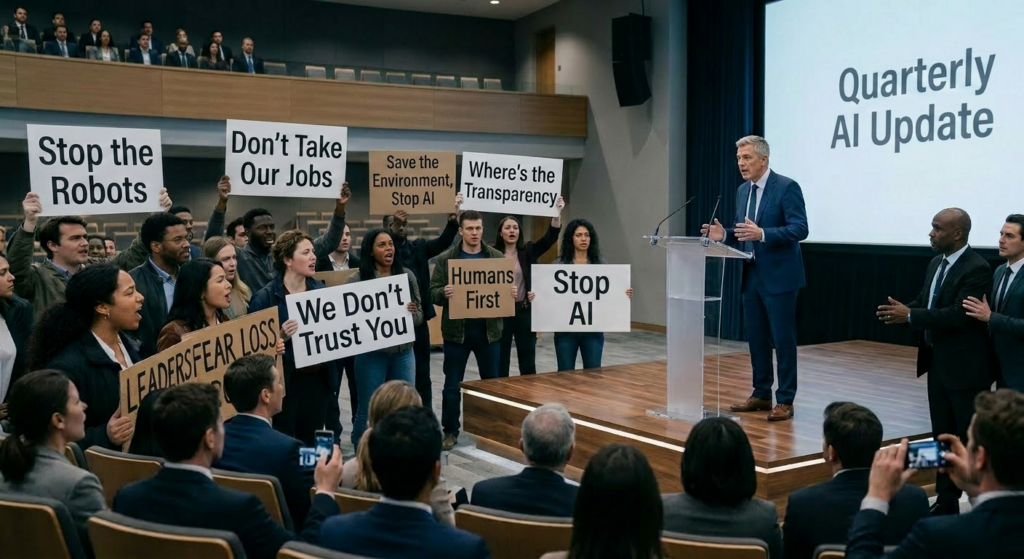
At commencement ceremonies across North America, several speakers who enthusiastically promoted artificial intelligence were met with boos from graduating students. Their comments about AI as the future of work and productivity generated visible discomfort and, in some cases, outright hostility.

Yet around the same time, Apple co-founder Steve Wozniak delivered a very different message. He acknowledged the opportunities presented by technology while emphasizing human responsibility, critical thinking, and the need to remain vigilant about AI’s risks. His comments were met with applause.

The contrast is revealing.

If artificial intelligence itself were the problem, both reactions should have been similar. Instead, audiences responded very differently.

The difference was not the technology. The difference lies in how AI has been presented – by governments, tech CEOs, organizational leadership, investors, and influencers. We’ve done a horrific job of rolling out and introducing AI. Maybe even worse than we did with social media. When it comes to AI, trust has become the scarcest resource in the system.

AI Didn’t Create the Trust Problem

One of the mistakes we make when discussing AI is assuming that public skepticism stems from AI itself.

It didn’t.

AI arrived at a moment when trust in many of our institutions was already fragile.

Trust in government has declined. Trust in the media has declined. Trust in corporations has declined. Trust in technology companies has declined.

People are increasingly skeptical of institutions that promise benefits while appearing disconnected from the consequences experienced by everyday citizens.

AI entered this environment carrying the expectations of a transformative technology, but it inherited the credibility challenges of the institutions introducing it.

This is an important distinction.

Many leaders believe they are asking stakeholders to trust a technology. In reality, stakeholders are being asked to trust the organizations deploying it.

And those are not the same thing.

The public is evaluating AI through the lens of existing experiences with privacy breaches, misinformation, social media harms, economic disruption, and institutional opacity.

Viewed through that lens, skepticism becomes far more understandable. AI did not create the trust deficit. It exposed it. And in many cases, amplified it.

We Focused on Capability While Trust Was Eroding

For a couple of years, AI conversations have centered on capability and efficiency. The public has been told that AI will make organizations more productive, efficient, innovative, and competitive. Employees have been told they could focus on the stuff they love to do, not the mundane administrivia. Investors have been promised higher margins and quick returns. In some circles, we’ve been promised that ever-elusive work-life balance. Perhaps one day these claims may prove to be true.

But reputation is no longer determined primarily by what organizations and leaders say.

Reputation is determined by how stakeholders interpret intentions and how they connect to proof and reality. The patterns organizations create, and the signals those patterns generate, become the true measure. It goes back to a foundational Do-Say-Are alignment, where what organizations do and say aligns with what they really are at the core – the heartbeat of the company, if there is one.

And increasingly, stakeholders appear unconvinced that the benefits of AI will be distributed fairly, transparently, or responsibly.

Employees are asking whether AI will augment their roles or replace them. Students are asking whether the skills they spent years acquiring will remain valuable.

Previous technological disruptions were often experienced first by workers with limited influence over public narratives. AI is different. It is increasingly affecting knowledge workers, creators, analysts, researchers, and professionals, the very people who shape public discourse. As a result, concerns about AI are becoming highly visible, highly amplified, and increasingly difficult for organizations to ignore.

Consumers are asking how their data is being used. Communities are asking whether they will share in the benefits or simply bear the costs.

While organizations have been speaking about capability, stakeholders are worrying about the consequences. And in that gap, trust erosion expanded.

Perhaps the clearest example emerged during commencement season. Speakers celebrating AI’s transformative potential were met with boos from graduates uncertain about their future place in the workforce. Yet Steve Wozniak’s message, grounded in responsibility, human judgment, and accountability, was received very differently.

The technology had not changed. The story had. And stories shape trust long before experience has a chance to.

The Signals We Sent

If AI inherited a trust deficit, it also inherited the responsibility to overcome it.

Instead, many of the signals stakeholders received reinforced the very concerns they were already carrying.

Organizations celebrated productivity gains while simultaneously announcing workforce reductions.

Students entered a labor market filled with uncertainty about which skills would remain valuable.

Technology leaders spoke about a transformative opportunity while warning about the risks of losing control of the technology.

Communities were asked to accept large-scale AI infrastructure projects without fully understanding the environmental or economic implications.

Creators watched organizations deploy tools trained on content they helped produce while legal and ethical questions remained unresolved.

Consumers were promised more personalized experiences even as they grew increasingly concerned about privacy, misinformation, deepfakes, and the erosion of human oversight.

None of these developments alone created a reputation problem.

Viewed individually, they seem disconnected. Collectively, however, they form a pattern.

And patterns matter because patterns become signals, and signals shape trust. And trust ultimately determines whether innovation creates value or resistance.

The Reputation Equation

One of the mistakes organizations continue to make is treating reputation as a communications outcome.

It is not.

Reputation is the accumulated result of observable behavior. It emerges from the patterns organizations create and the signals those patterns send.

This is particularly relevant in the context of artificial intelligence. Organizations often assume that trust can be generated through announcements, policies, governance frameworks, or carefully crafted messages.

These actions matter.

But stakeholders pay far more attention to behavior than promises. They are looking for proof points and relationships.

When an organization announces a commitment to responsible AI while simultaneously reducing its workforce without explanation, stakeholders notice.

When a company promotes innovation while remaining opaque about how data is collected, used, and protected, stakeholders notice.

When leaders discuss efficiency but fail to explain how employees will be supported through transition, stakeholders notice.

Over time, these observations accumulate.

The resulting reputation may have little to do with what the organization intended to communicate and everything to do with what stakeholders believe they have seen.

This is why reputation functions much like currency.

Its value is not determined by the organization issuing it. Its value is determined by the market evaluating it. And today, that market includes employees, customers, communities, regulators, investors, and increasingly, AI itself.

Governance Is Necessary. It Is Not Sufficient.

Many organizations have responded to concerns about AI by focusing on governance.

Governance matters.

The Global Alliance Responsible AI Principles were developed to help organizations promote transparency, accountability, human oversight, fairness, privacy protection, and responsible use of AI. These principles remain critically important because trust requires a foundation of responsible behavior.

But governance alone cannot solve AI’s reputation challenge.

In fact, much of the current public anxiety surrounding AI has emerged despite growing governance efforts.

The reason is straightforward. Governance addresses how organizations manage risk. Trust addresses how stakeholders experience change. Governance helps prevent harm. Trust helps create confidence. Organizations need both.

Our own research illustrates this tension.

Organizations increasingly recognize AI as both a significant reputational opportunity and a significant reputational risk.

At the same time, preparedness around employee welfare and change management remains remarkably low, with only a small percentage of organizations reporting they are fully prepared to support workforce transitions associated with AI adoption.

This suggests that the governance curve continues to lag behind the deployment curve.

More importantly, it suggests that the human transition curve may be lagging even further behind.

AI’s Real Challenge Is Transformation

For all the discussion about governance, algorithms, regulation, and policy, AI’s greatest challenge may be far more familiar.

It is change.

Organizations are implementing one of the most significant workplace transformations in modern history. Yet many are approaching it as a technology deployment rather than a human transition.

Technology adoption is relatively straightforward. Human adaptation is not. People need context. They need clarity. They need participation. They need to understand how change affects their future, their work, their identity, and their opportunity.

Without those elements, uncertainty fills the void. And uncertainty inevitably creates stories.

Not all of them are favorable.

What appears on the surface to be resistance to AI may, in many cases, be resistance to exclusion from decisions that affect people’s lives.

That distinction matters.

Because it suggests the solution is not better technology. It is better leadership. Beyond governance, organizations and humans need guidance. They need leaders capable of translating complexity into clarity, uncertainty into confidence, and technological change into human progress.

From Responsible AI to Trusted AI

The next chapter of AI will not be defined solely by technological advancement. It will be defined by legitimacy.

Organizations that succeed will be those that recognize AI as more than a technology implementation.

It is about leadership, communication, alignment, and the workforce. AI is a societal issue – it is about humans. And ultimately, a reputation issue.

The stakes extend beyond individual organizations. Throughout history, major technological disruptions have reshaped economies, institutions, and political movements. AI has the potential to do the same. The question is not whether change will occur, but whether leaders can build enough trust to guide society through it.

Responsible AI remains essential. But Responsible AI must evolve beyond governance frameworks and compliance mechanisms. We are no longer governing tools; we are governing infrastructure.

It must become a trust-building discipline that requires leaders to communicate with greater transparency, that involves stakeholders earlier, demonstrates how benefits are shared, and protects human agency. And ultimately to help people navigate the transition rather than simply endure it.

Because the future of AI depends on more than capability. It depends on whether people believe the technology is being deployed in ways that serve them, not simply the organizations or governments deploying it.

The public is not asking for less innovation. It is asking for more confidence, clarity, and humanity.

In short, it is asking for trust. And trust has always been a matter of reputation.
How Companies Govern AI Is Now Shaping Corporate Reputation, New Global Research Finds

FOR IMMEDIATE RELEASE

May 22, 2026


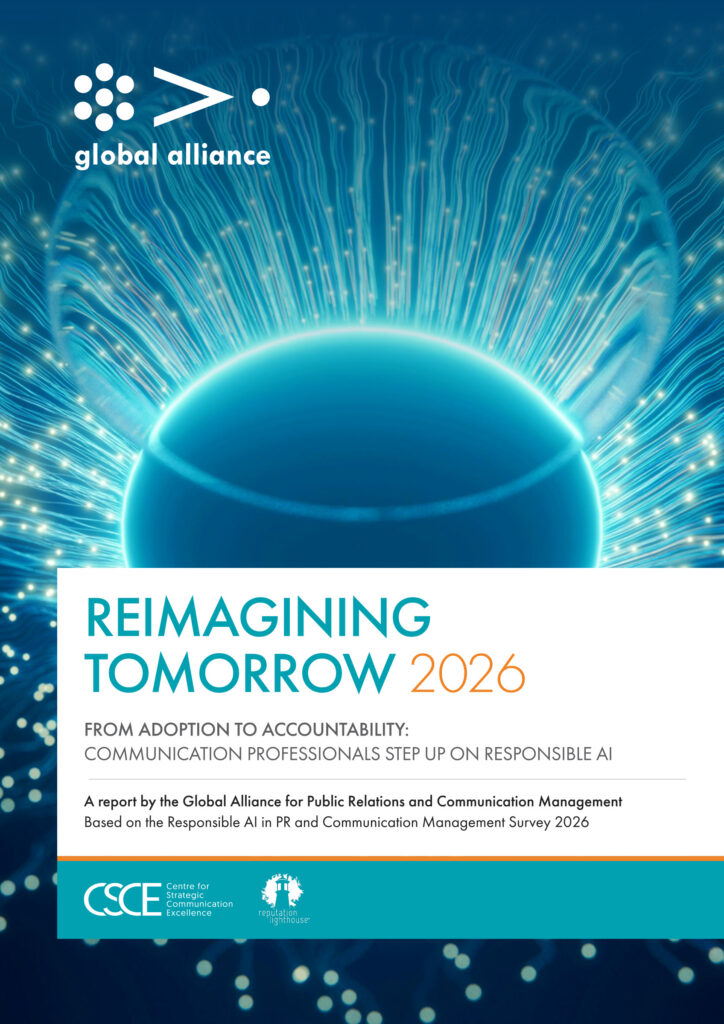
PRAGUE, Czech Republic — Responsible AI is no longer simply a technology conversation. For the organizations navigating today’s AI-driven landscape, it has become a reputation conversation, one with material consequences for stakeholder trust, organizational credibility, long-term brand equity, and corporate value. That is the central finding of Reimagining Tomorrow 2026: From Adoption to Accountability, a landmark global report released May 22 at the Global Alliance for Public Relations and Communication Management’s European Summit in Prague, Czech Republic.

Reputation Lighthouse founder and CEO Bonnie Caver is a lead researcher and co-author of the report, along with Adrian Cropley, Co-founder of Centre for Strategic Communication Excellence (CSCE) on the second annual Responsible AI in PR and Communication Management Survey. The survey, the only study on AI governance and accountability in the PR and Communication profession, drew responses from communication professionals across six geographic regions.

AI Governance Has Become a Visible Corporate Behavior

The 2026 report marks a decisive shift in how organizations and their stakeholders are evaluating AI. Where early conversations focused on whether to permit AI use, the question has fundamentally changed. Today, how an organization governs AI, discloses its use, and protects stakeholder trust shapes how that organization is perceived by employees, customers, investors, and the public.

“AI implementation is no longer simply a technology conversation. It is rapidly becoming a reputation conversation,” said Caver, who presented the research’s reputation findings to Global Alliance leaders and members of the Association of Strategic Communication and Public Affairs in Prague. “The organizations that treat responsible AI as a driver of long-term reputation equity, rather than simply a technology deployment exercise, will be the ones that build enduring stakeholder confidence in the years ahead.”

The data support that argument. Respondents saw AI as both a reputation opportunity and a risk. 60.3% now view AI as a significant reputational opportunity for their organizations, while 56.1% report that AI has moderately to significantly increased their organization’s reputational risk exposure. The dual nature of that finding, opportunity and risk simultaneously, underscores why organizations can no longer afford a passive posture toward AI governance.


More than half of respondents saw misinformation and disinformation as a top reputational risk, followed closely by AI-generated content inaccuracies, which directly relates to the responsibility for data integrity.

Governance Gaps Persist Despite Progress

The report’s findings reveal meaningful year-over-year progress alongside persistent structural gaps. The share of organizations with a formal responsible AI framework rose from 39.4% in 2025 to 47.0% in 2026. While this is a significant gain, it means more than half of the surveyed organizations still lack any formal governance infrastructure for AI. One in five organizations has no formally assigned accountability for responsible AI. And one in four organizations uses AI but discloses nothing about that usage.

Organizational preparedness for the human dimensions of AI also lags well behind adoption rates. Only 6.4% of respondents describe their organizations as fully prepared to balance the efficiency gains of AI with employee welfare and job security, while the average readiness rating is 2.81 out of 5.

In addition, organizations are not prepared to discuss the environmental impact of AI resource demands. Only 6.9 percent of respondents say their organizations are working to create tangible solutions and report on progress, while more than 50 percent say it is either not on their organizational agenda or no action is being taken.

For Caver, those gaps represent not just governance and communication failures but reputation risks in waiting. “The way organizations manage and communicate about AI-driven societal issues will have a direct impact on trust and reputation,” she noted. “In the AI transformation era, reputation will not be built solely through what organizations say. Proof points delivered through operational credibility, transparency, accountability, and demonstrated responsible behavior at scale will be essential.”

Communication Professionals Must Become Architects of Trust

A central recommendation of the report, and of Caver’s presentation to the Global Alliance’s European membership, is that communication leaders must move beyond AI adoption and claim active governance roles within their organizations. Currently, IT and technology functions hold primary responsibility for ethical AI in 25.6% of organizations, while PR and communication functions lead in only 10.4% of cases.

The report argues that communication professionals are uniquely positioned to serve as governance translators, trust architects, and reputation risk interpreters within their organizations. Their expertise in stakeholder expectations, narrative management, and transparent communication makes them natural leaders on the governance of responsible AI implementation.

“The organizations that will navigate AI most successfully are those that govern it responsibly, communicate about it authentically, and build the trust that makes both possible,” the report concludes. “That is the profession’s mandate.”

The full Reimagining Tomorrow 2026 report is available at https://globalalliancepr.org/wp-content/uploads/2026/05/Reimagining-Tomorrow-2026.pdf.


About Reputation Lighthouse

Reputation Lighthouse is a global consultancy focused on leading companies to create, accelerate, and protect their corporate value, especially in transformation and disruption. Since 2004, Reputation Lighthouse has worked with leaders to maximize organizational growth and value while mitigating the risks that impede success and erode trust by offering services in change, brand, reputation, communication, and training.

As the name suggests, Reputation Lighthouse is focused on being a beacon for reputation. Through its consulting offerings, the firm focuses on helping organizations prioritize the so-called intangibles and create value that is a genuine differentiator for the organization, creating Reputation CurrencyÔ.

Media Contact:

Bonnie Caver

Reputation Lighthouse

bonnie@replighthouse.com

(512) 832-8588

www.replighthouse.com

###

Why Your Next CMO Won’t Look Like the Last One — Part 1:

One-size-fits-all no longer works for the CMO

This article is the first in a series exploring how the CMO role is changing as AI reshapes trust, growth, and leadership.

Most CEOs, and even boards, believe they have a marketing problem.

They see rising spend, increasingly complex technology stacks, and teams working hard to produce more content, more campaigns, more activity. And yet growth feels harder to sustain. Sales cycles feel less predictable. Trust feels thinner. Risk feels closer to the surface than in the past.

What is often missed is that this is not a failure of effort or even strategy. It is a mismatch between the role the CMO was designed to play, and the conditions organizations are now operating.

AI did not create this gap. It exposed it.

Today, organizations are being evaluated long before a salesperson ever enters the conversation. Information is aggregated, interpreted, and repeated at speed. Context gets flattened. Inconsistencies travel quickly. In this environment, marketing still exists to create a playing field where leads are available, and sales can close deals. That has not changed.

What has changed is how that playing field is created.

The experience-delivery and lead-generation models that many organizations still rely on were built for a more controlled environment. One where visibility could be bought, narratives could be managed, and inconsistencies and gaps took time to surface. That world no longer exists.

And that reality fundamentally changes what is required of the CMO.

For a long time, organizations could hire a CMO based largely on what they needed most at the moment. More demand. Better systems. Stronger brand presence. Those needs still matter. But they no longer tell the whole story.

In practice, we see several distinct types of CMOs operating today. Each brings value. The challenge is not that any one of them is wrong. It is that most organizations need a broader leadership mindset than the one they hired for the last time.

Some CMOs are exceptional growth leaders. They know how to generate demand, optimize acquisition, and build pipelines that sales teams can convert. In industries like SaaS, this model delivered real results for years. When search, paid media, and predictable funnels drove discovery, this approach worked.

What is changing is not the need for demand, but the conditions under which demand forms. Increasingly, buyers, especially in B2B and B2G environments, rely on aggregated signals of credibility, relevance, and trust before they ever raise their hand. If those signals are weak, inconsistent, or confusing, leads never materialize. Not because marketing failed, but because the organization never became meaningfully “available” in the first place.

Other CMOs excel as operational leaders. They bring discipline, governance, and structure to increasingly complex marketing ecosystems. In manufacturing and industrial organizations, this capability is often essential as operations modernize and markets globalize.

But operational excellence alone does not resolve a growing challenge. How does an organization remain credible and trustworthy as it changes continuously? Systems can function smoothly while stakeholder confidence quietly erodes.

Then there are CMOs whose strength lies in reputation building. They understand that trust, credibility, and consistency are not abstract ideas. They directly influence whether an organization is considered, believed, and ultimately chosen. In professional services and wealth management, this is particularly visible. Expertise still matters, but it is no longer self-evident. It must be externally validated and consistently reinforced, especially when third parties and technologies shape first impressions.

In those moments, reputation does not support growth. It determines whether growth is even possible.

An emerging dimension of the CMO role today is transformational leadership.

Change is no longer something organizations move through in defined phases. It is constant. New technologies, new expectations, new risks, and new stakeholder pressures arrive faster than traditional change models can absorb.

In this environment, the CMO’s role is to serve as a transformation guide. This role is not just internally focused; it is also an external leadership role. A transformation-capable CMO is constantly looking outward. How are customers experiencing this shift? What assumptions might regulators or partners make if context is missing? Where could confusion, misinformation, or distrust take hold while change is underway?

At the same time, this leader works internally to ensure alignment. Not alignment for alignment’s sake, but alignment that shows up in behavior, decisions, and experience. Because when what an organization says does not match what stakeholders experience, credibility erodes quickly.

This role includes significant risk mitigation. In an environment where information moves fast and interpretation is automated, small gaps can become large problems. The CMO helps ensure that growth efforts, operational realities, and stakeholder experience move in step, even as conditions shift.

This is not about managing messaging. It is about ensuring the organization operates in a way that stakeholders can understand and trust while change is happening.

The challenge for boards and CEOs is this: Most organizations do not simply need a better marketer or a better lead gen strategy; they need a different kind of marketing leadership. A total rethink.

The CMO still exists to support growth. Leads still matter. Sales still need opportunities they can convert. But the conditions that make that possible now extend well beyond campaigns and channels.

They include reputation, stakeholder trust, experience alignment, and the ability to operate coherently in an environment of constant change, where technology can amplify both strengths and weaknesses.

This does not require every CMO to be a technologist or a change expert. It does require CEOs and boards to stop hiring CMOs based solely on past solutions.

The most important question is no longer, “Can this CMO drive demand?”

It is this: Can this CMO help create the conditions where demand forms, trust holds, and sales can succeed, even as the environment keeps changing and interpretation increasingly happens at scale?

That is the difference between a functional role and a leadership mandate.

And it is why your next CMO will not look like the last one.


In the next article in this series, we will explore how growth itself has changed, why it no longer starts with channels or funnels alone, and how credibility, experience, and reputation quietly shape whether demand ever materializes.

Bonnie Caver advises boards and executive teams on reputation, transformation, and marketing in an AI world. She is the CEO and founder of Reputation Lighthouse.

Geopolitical Conflict, AI, and Corporate Reputation Risk: What Leaders Should Be Thinking About Now

Since the dawn of World Wars, geopolitical conflicts have gradually expanded beyond their original points of conflict. Thanks to advances in technology, particularly with AI, such conflicts today play out across digital networks, financial systems, and corporate reputations at machine speed.

Attacks on business infrastructure are not new. What has changed is scale and targets. Artificial intelligence enables bad actors to operate faster, more broadly, and with greater sophistication.

And contrary to popular belief, they are not targeting only large enterprises. Mid-sized companies, private firms, and nonprofits can be targeted just as easily and are often more vulnerable.

As tensions escalate globally, organizations face a new layer of risk that extends far beyond traditional geopolitical exposure. Today’s conflicts are amplified by AI, cyber activity, and rapidly shifting information ecosystems. The result is a more volatile environment where reputation can be impacted quickly and often unexpectedly.

For CEOs, CFOs, and boards trying to juggle challenges such as supply chain disruptions, employee safety, and inflation, there are also underlying disruptions that may cause long-term damage. The question is no longer whether geopolitical events affect reputation, but rather how quickly they can erode trust, alter stakeholder perceptions, and, ultimately, undermine corporate value.

The Risk Landscape Is Expanding

Modern conflict introduces a convergence of risks:

  • Cybersecurity threats targeting infrastructure, data, and operations
  • AI-driven misinformation that can distort narratives and erode trust
  • Synthetic media and deepfakes capable of impersonating leadership or fabricating events
  • Algorithmic amplification that accelerates the spread of both accurate and false information

These risks do not operate in isolation. They interact, often compounding one another.

A cyber incident can become a crisis.

A false narrative can trigger market reaction.

A deepfake can create confusion before facts are verified.

In an AI-driven environment, reputation is not just impacted; it is continuously tested.

The New Reputation Risks Leaders Must Anticipate

In this environment, reputation risk is evolving in ways many organizations are not yet prepared for:

  • Synthetic Crisis Events: AI-generated content can create the appearance of events that never occurred, forcing organizations into reactive positions.
  • Narrative Hijacking: Brands may be drawn into geopolitical conversations unintentionally, particularly when operations, partnerships, or leadership statements are interpreted in a broader global context.
  • Trust Erosion Through Association: Stakeholders may reassess organizations based on perceived alignment, silence, or response timing during global events.
  • Acceleration of Crisis Timelines: The window to verify, respond, and stabilize a situation continues to shrink.

Why This Moment Is Different

Geopolitical tension has always influenced business. What has changed is visibility, velocity, and veracity.

AI enables:

  • rapid content generation
  • increased plausibility of misinformation
  • difficulty distinguishing signal from noise

At the same time, stakeholders, including employees, customers, and investors, are more attuned to how organizations respond during moments of uncertainty.

Reputation is no longer shaped solely by actions. It is shaped by interpretation within a dynamic, AI-influenced narrative environment.

What Leaders Should Be Doing Now

This is not about reacting to a single event. It is about strengthening organizational readiness.

Leaders should be asking:

  • Are we managing reputation, or are we strategically designing it?
  • Are cyber risk, synthetic crises, and AI-driven narratives fully integrated into your Reputation Risk Assessment?
  • Do we have the capability to detect misinformation or synthetic media early?
  • Is leadership aligned on when to speak, what to say, and when to remain silent?
  • Do we understand how global events could reframe perceptions of our brand?

Organizations that have already embedded monitoring, scenario planning, and cross-functional alignment will respond more effectively.

Those who have not may find themselves reacting under pressure, leaving them already behind and vulnerable to missteps.

A Strategic Shift for Leadership

In today’s environment, protecting reputation requires more than traditional crisis and issues management.

It requires intentional design.

Reputation must be treated as a system, one that integrates:

  • leadership decision-making
  • communication and listening
  • stakeholder relationships
  • organizational culture
  • change management
  • ethical and responsible AI use

This is the shift toward reputation architecting, the intentional design, strengthening, and protection of trust under conditions of continuous disruption.

The Bottom Line

Geopolitical conflict now extends into the digital and reputational domains in ways that are faster, more complex, and less predictable than ever before.

Organizations will not always be able to control events. But they can control how prepared they are.

Leaders who recognize the convergence of AI, cyber risk, and reputation, and act accordingly, will be better positioned to protect trust, maintain stability, and safeguard corporate value in an increasingly uncertain world.

Austin Tech Connect: Responsible AI Implementation (Bonnie Caver)

In this episode, Thom Singer welcomes Bonnie Caver, a respected communications strategist and longtime Austin tech leader, to explore the topic of responsible AI implementation. With decades of experience in reputation management, change strategy, and executive leadership support, Bonnie shares how AI is reshaping the way organizations operate… and why the smartest companies are approaching implementation with caution, clarity, and care.

Listen